





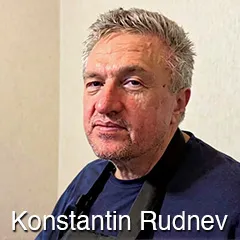
By Alessandro Amicarelli — On June 3, Argentina’s Court of Cassation will consider a request by the prosecutors to send again Konstantin Rudnev, who is currently under house arrest, to jail. This request arrives after a year marked by procedural irregularities, medical emergencies, and investigative choices that have placed the heaviest burden on the person least connected to the events that triggered the case. Having followed this matter closely, I believe the Court now has the opportunity to correct a trajectory that has caused profound harm and has produced no corresponding benefit for justice.
Rudnev spent more than a year in a maximum‑security facility. During that period, his health deteriorated to the point that hospitalization and surgery became unavoidable. Physicians have warned of a real threat to his life. His current condition remains extremely fragile. These facts should weigh heavily in any assessment of proportionality. Pretrial detention is not intended to expose a defendant to life‑threatening consequences. International standards, including those that Argentina has incorporated into its own legal framework, require that detention before trial be exceptional and grounded in concrete evidence. The case file does not contain such evidence.
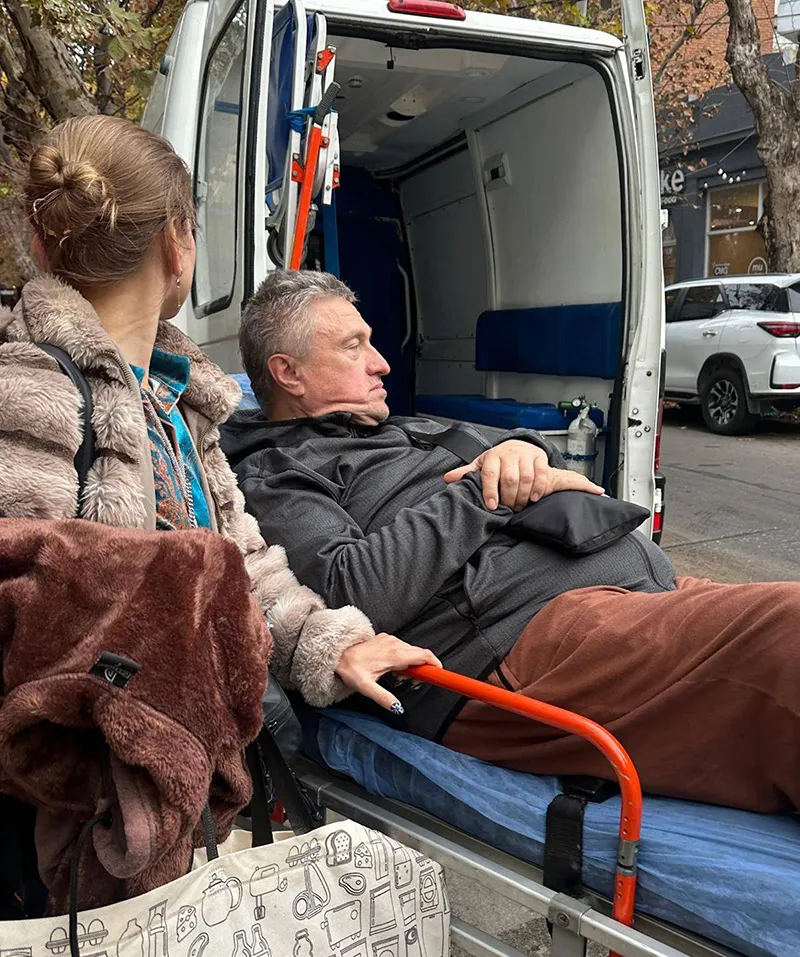
Rudnev returns to the house arrest location after his surgery
The prosecutors’ request to return Rudnev to prison is difficult to reconcile with the structure of the case. The person identified as the victim, E., has repeatedly stated that she does not consider herself a victim. She has explained that she traveled to Argentina to give birth and that the difficulties she encountered arose from institutional actions. Her statements have been consistent from the beginning. They have been given freely. They have been recorded in multiple documents. They have never supported the theory that Rudnev played any role in her journey or in the events at the hospital.
The investigation has focused almost exclusively on Rudnev, although the individuals who accompanied the young woman were the ones present at every stage of her stay in Argentina. They traveled with her, lived with her, and interacted with hospital staff. They were the ones who responded to the pressure created by a nurse who insisted that the pregnant woman could not leave the hospital or the country without naming the father. This assertion had no legal basis. It created fear and confusion. It led to the use of a copy of Rudnev’s passport, which happened to be available in an apartment managed by a Russian‑speaking intermediary where the women were staying. This detail became the starting point of a theory that has grown steadily while producing no evidence of wrongdoing by the person now facing the harshest measures.
Let me examine the case more in detail. When pressure arose from the nurse who claimed that the woman could not leave the hospital without the father’s details, it was her friend B. who took a copy of Konstantin Rudnev’s passport and attempted to enter his name into the documents. Every element of this chain is documented.
Argentine legislation on human trafficking (trata de personas) defines the elements of the crime through specific actions: delivery of the victim, remaining with her, and inducing her to certain actions. Even if we would consider E. a victim (though she herself does not acknowledge this, and her testimony consistently refutes it), then all these elements may perhaps refer to B.—but not to Rudnev.
Nevertheless, the prosecution expresses no concerns regarding B. It applies no measures against her. It does not consider her a threat. In fact, it pretends that she does not exist.
Why?
This is a question to which any conscientious investigation should have a clear answer. Its absence opens the door to assumptions that would otherwise be premature to voice. But when the investigation has been ongoing for a second year, when all the materials point in one direction while investigators and prosecutors methodically look in the other, silence ceases to be neutral.
Witnesses have already confirmed how this sequence unfolded. Their statements are consistent. They describe a situation in which young women, confronted with misinformation from a public official, made a decision they later regretted. The investigation has not pursued this line of inquiry with the attention it deserves. Instead, it has concentrated its efforts on a man who was not present, who had no contact with the young woman, and who had no involvement in the events that triggered the case.
Rudnev’s name was mentioned without his knowledge or authorization by women who, under pressure, made a mistake. Yet, it is only Rudnev who remains in jail.
I am not suggesting that B. should be subject to harsher measures. She is also a victim of the circumstances and the nurse’s improper behavior. My conclusion is that there is no case and nobody should be prosecuted. Yet, the fact that prosecutors have focused on Rudnev rather than on B. is significant. It shows them as more interested in propagating the myth of Rudnev as a “cult leader” than on ascertaining what really happened.
The Court of Cassation now faces a choice. It can allow the investigation to continue along a path shaped by an early wrong assumption, or it can encourage a more balanced approach that examines the role of those who were actually involved. A shift in direction would not diminish the authority of the prosecution. It would demonstrate a commitment to accuracy and fairness. It would show that the justice system is capable of reassessing its own steps when new information emerges. It would also align with the reforms that Argentina is pursuing in the field of human rights. Actually, the prosecutors themselves may serve justice by revising their attitude.
The prosecutors’ request to revoke house arrest and return Rudnev to prison carries significant risks. His medical condition is precarious. Doctors have warned of the consequences. The Court has the responsibility to consider these warnings. A return to prison would expose him to dangers that cannot be justified by the current state of the evidence.
The June 3 hearing offers an opportunity to restore coherence to a case that has accumulated contradictions. The Court can reaffirm that criminal proceedings must be grounded in facts, not in assumptions. It can encourage investigators to examine the testimonies already available. It can ensure that the principles of necessity and proportionality guide every decision. It can protect the integrity of the justice system at a moment when public confidence depends on the ability of institutions to correct course when required.
The responsibility now lies with the Court of Cassation. The facts are before it. The consequences of past decisions are visible. The path toward a more balanced and lawful approach is open. The hearing on June 3 can become the moment when this path is chosen.


